Highlights
-
Foundational Framework: High-quality pre K programs build essential phonological awareness, receptive language, and print knowledge through structured daily play and targeted verbal interaction.
-
Decoding Mechanics: Early childhood educators use interactive read-alouds, alphabet rhymes, and guided sound segmentation to demystify how spoken language translates into written text.
-
Emergent Writing Development: Classrooms connect fine motor fine-tuning directly with symbolic communication, helping children progress systematically from random scribbles to recognizable letterforms.
-
Contextual Comprehension: By weaving rich vocabulary into hands-on sensory centers, early learning settings equip young learners with the background knowledge required for long-term reading comprehension.
-
Social and Emotional Literacy: Group storytelling and collaborative dramatic play cultivate the attention span, conversational turn-taking, and confidence necessary for academic success.
-
Long-Term Trajectory: Early childhood literacy interventions prevent learning gaps before kindergarten, directly raising elementary reading fluency, academic confidence, and standardized assessment performance.
What Role Does Pre-K Play in Early Childhood Literacy?
Pre-K serves as the critical bridge connecting informal conversational speech with formal reading and writing instruction. Before children enter primary school, their brains undergo exponential development in language processing networks. A structured pre K classroom immerses students in rich, responsive verbal environments where language is continuously modeled, unpacked, and celebrated.
According to the National Association for the Education of Young Children (NAEYC), early literacy acquisition flourishes when children encounter diverse texts, meaningful conversational exchanges, and expressive dramatic play in their formative years. When educators systematically introduce new vocabulary across diverse contexts, children expand both their receptive and expressive lexicons.
How Does Pre-K Develop Emergent Reading and Phonological Awareness?
Pre-K develops emergent reading by breaking spoken language down into distinct sounds and teaching children to map those sounds to written symbols. This critical skill set, broadly recognized as phonological awareness, empowers young learners to identify rhymes, isolate initial consonants, blend syllables, and segment distinct acoustic sounds within spoken sentences.
Research compiled by the National Institute for Early Education Research (NIEER) highlights that learning to read starts long before formal kindergarten instruction begins. Print awareness represents another major pillar nurtured in early classrooms. Young learners discover that books are read from left to right and top to bottom, that spaces separate words, and that illustrations illustrate the adjacent narrative text.
Which Classroom Practices Most Effectively Accelerate Early Reading?
Classroom practices accelerate early reading by transforming foundational mechanics into engaging, sensory-rich investigations that make phonetic exploration intuitive and fun. By designing interactive learning centers tailored to multiple learning styles, educators help children bridge the gap between concrete objects and abstract printed letters:
-
Interactive Shared Storybook Sessions: Educators pose open-ended predictive questions during group reading, challenging children to analyze character motivations, anticipate upcoming narrative events, and infer underlying plot points.
-
Tactile Letter Manipulation: Students shape alphabet characters using modeling clay, trace letter grooves in sand trays, and assemble wooden puzzle pieces to develop durable muscle memory for distinct letter patterns.
-
Environmental Print Integration: Instructors label classroom cubbies, supply containers, and interest corners with clear print and visual iconography, reinforcing the idea that writing communicates useful information.
-
Systematic Syllable and Rhythm Games: Children clap out syllable counts for classmates’ names, sort rhyming picture cards into matching buckets, and sing alliterative verses to hone auditory discrimination.
-
Immersive Listening Centers: Small group stations equipped with recorded audiobooks allow emerging readers to follow along with physical picture books, linking auditory cues to printed text independently.
How Does Pre K Scaffold Emergent Writing and Fine Motor Development?
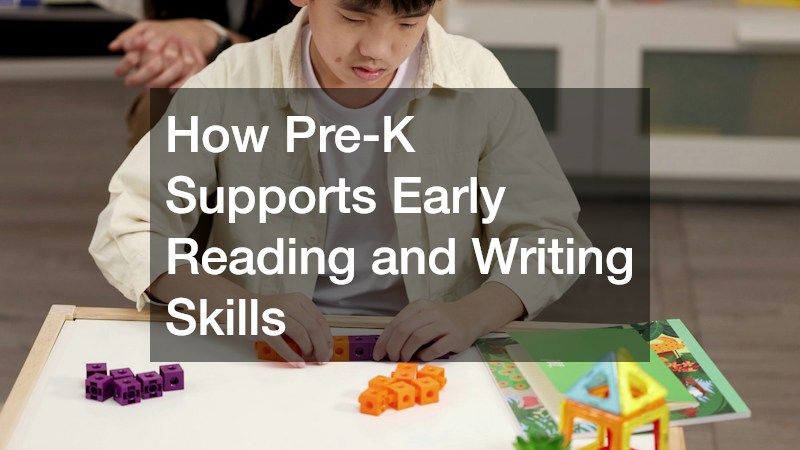
Pre K scaffolds writing by developing the physical dexterity, hand-eye coordination, and symbolic reasoning required to turn thoughts into legible marks. Before a child can form recognizable letters on lined paper, their hands require muscular strength and refined neuromuscular control. Early childhood classrooms prioritize these prerequisite physical competencies through varied motor activities, including squeezing dough, threading beads, snipping paper strips with safety scissors, and manipulating tweezers in sensory bins.
Early educators encourage children to express narrative ideas through emergent drawing, scribbling, and mock-letter forms. In dedicated writing centers, students design homemade greeting cards, scribble pretend grocery receipts, and draft captions underneath their personal illustrations.
What Are the Core Stages of Writing Observed in Early Learners?
The core stages of early writing follow a predictable developmental continuum, moving from gross motor physical marks toward phonetically accurate, standardized letterforms:
-
Spontaneous Scribbling and Random Mark-Making: Toddlers and young preschoolers explore drawing tools, producing open looping strokes that reflect purely kinetic physical exploration without intentional symbolic meaning.
-
Controlled Linear Scribbling: Children begin mimicking adult writing conventions by arranging continuous zig-zag lines or horizontal loops across horizontal margins from left to right.
-
Mock Letters and Symbolic Shapes: Emergent writers generate distinct standalone figures resembling circles, crosses, and angled strokes, occasionally creating accidental approximations of real letters.
-
Letter Strings and Name Writing: Children deliberately reproduce memorized letters—typically those featured in their own first names—in unordered strings without consistent phonetic correspondence.
-
Transitional Invented Spelling: Young writers purposefully isolate the dominant beginning and ending sounds of spoken words, writing matching consonants (such as spelling cat as “KT” or sun as “SN”).
-
Conventional Form Assembly: Students combine recognizable uppercase and lowercase letters, maintain intentional word spacing, and construct basic phonetic words to convey original narrative statements.
Educators validate early scribbles as authentic written communication, frequently asking students to dictate the meaning behind their marks so the teacher can scribe the actual words below.
How Does Early Literacy Instruction Shape Long-Term Academic Outcomes?
Early literacy instruction shapes long-term academic outcomes by establishing self-sustaining cognitive pathways, strong oral confidence, and an intrinsic enthusiasm for reading. When children enter elementary school with a well-developed grasp of letter sounds, narrative structure, and print mechanics, their cognitive bandwidth remains open to absorb higher-level comprehension strategies rather than struggling with basic letter recognition.
Guidelines published by the American Academy of Pediatrics (AAP) emphasize that immersive shared reading and early linguistic stimulation foster neurological resilience, emotional bonding, and executive functioning. Beyond test scores, early literacy programs nurture communicative agency, allowing children to advocate for themselves, collaborate constructively with classmates, and articulate their emotions clearly.
Investing in early literacy during the pre K years is one of the most effective ways to nurture capable, self-assured readers and writers. By combining systematic phonetic games, language-rich storytelling, and open-ended fine motor play, early childhood programs demystify literacy and weave it naturally into everyday life. These experiences provide young minds with the essential cognitive scaffolding, physical readiness, and expressive confidence needed to step into elementary education fully prepared to thrive.
Sources:
National Association for the Education of Young Children (NAEYC)
National Institute for Early Education Research (NIEER)